
ECCV 2026, accepted as a poster
CrossView: Can Vision-Language Models Reason Across Cameras?
Sahil Shah, S P Sharan, Harsh Goel, Manvik Pasula, Adithya Hebbalae, Minkyu Choi, Sandeep P. Chinchali
Loading
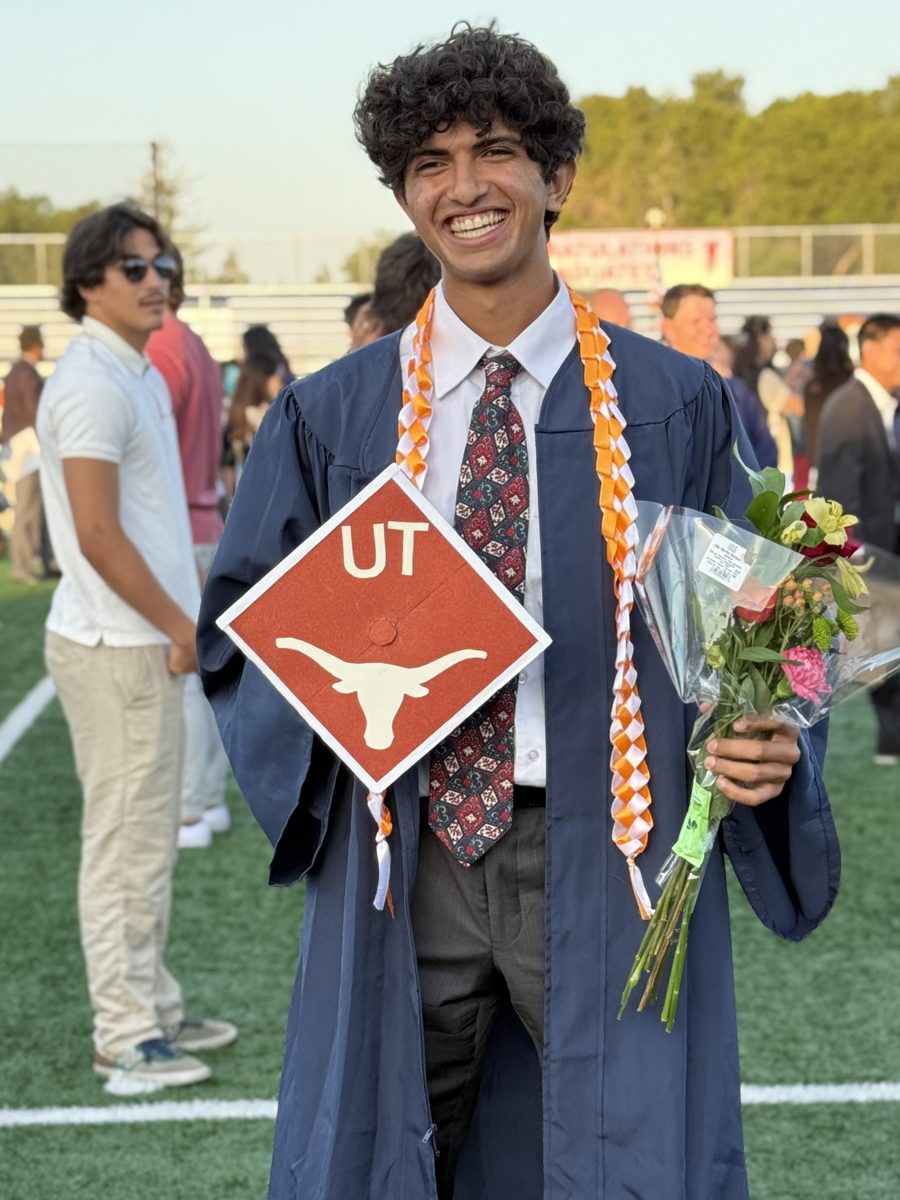
I study electrical and computer engineering at UT Austin, build research datasets in the SWARM Lab, and make software that other students actually use.
I grew up in Saratoga, California, and now study electrical and computer engineering at UT Austin, mostly computer architecture and embedded systems.
I started coding at 8, making a game in Scratch. The way I learn has not changed much since: pick something I do not understand, build with it, and find out where it breaks.
Most of my week goes to the SWARM Lab, working on whether vision-language models can reason across cameras. The rest goes to the projects below and to the Texas Poker Club, which I co-founded.
In high school I captained cross-country and track, played second violin in the orchestra, co-captained and choreographed for the dance team, co-founded the geography club, and coached middle school track.
ECCV 2026, accepted as a poster
Sahil Shah, S P Sharan, Harsh Goel, Manvik Pasula, Adithya Hebbalae, Minkyu Choi, Sandeep P. Chinchali
UT Austin ECE, Chinchali Group
Undergraduate Researcher, Sept 2025 to present
The lab needed a way to tell whether a vision-language model actually reasons across cameras or just answers from whichever single view it was given. That became CrossView, a 6,000-question benchmark over four multi-camera datasets.
I owned one of the four: MEVA, surveillance video from 28 cameras across four sites. Its annotations record that an activity happened, not who did it, so before any question about a person could exist I had to tie activities to people from bounding boxes and camera geometry. The first version handed question generation to an LLM. Moving it into a symbolic layer made every answer computable from the annotations, and regenerating the whole dataset went from about $50 to $1.86.
MEVA turned out to be the subset models score lowest on in every category. Over summer 2026 I stayed on as a funded research assistant on a multi-camera scene understanding project with the Air Force Research Laboratory, and presented our findings to the sponsor.
University of Utah
Student Researcher, Jun to Sept 2024
Undersampled MRI scans finish faster but come back with artifacts. The usual correction trains a network on ground-truth reconstructions. Deep Image Prior does not need any, because the structure of the network does the regularizing, so it runs unsupervised on the scan in front of it.
My work was on convergence for cardiac MRI: reaching a good reconstruction in 40% less training time, checked with PSNR and SSIM.
Things I built on my own time. Most of them are still running.
Four-year degree planner and next-semester schedule optimizer for UT Austin ECE.
Degree planning is a constraint problem, so the solver is code and the LLM only explains.
TypeScript, React 19, Vite, Tailwind CSS
A local browser daemon that gives coding agents a one-call UI verification report.
Built because hand-checking my own UI after every agent edit was the bottleneck.
Node.js, JavaScript (ESM), Playwright, Chrome DevTools Protocol
An accountability index for UT Austin student housing, built on Austin public records.
A zero-dependency Node pipeline that commits its own raw data to git as the audit trail.
Node.js, JavaScript, Astro, Cloudflare Pages
A Chrome Web Store extension that tells UT students the moment a lecture poll opens.
The public site for the UT student poker club I co-founded. Astro on Cloudflare.